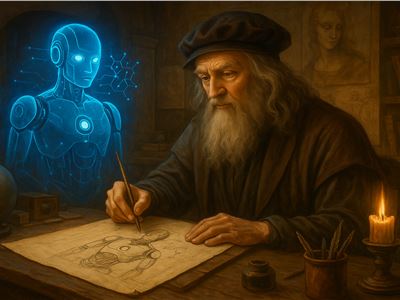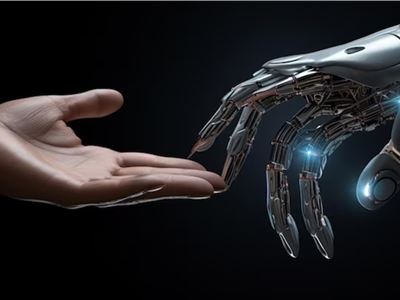
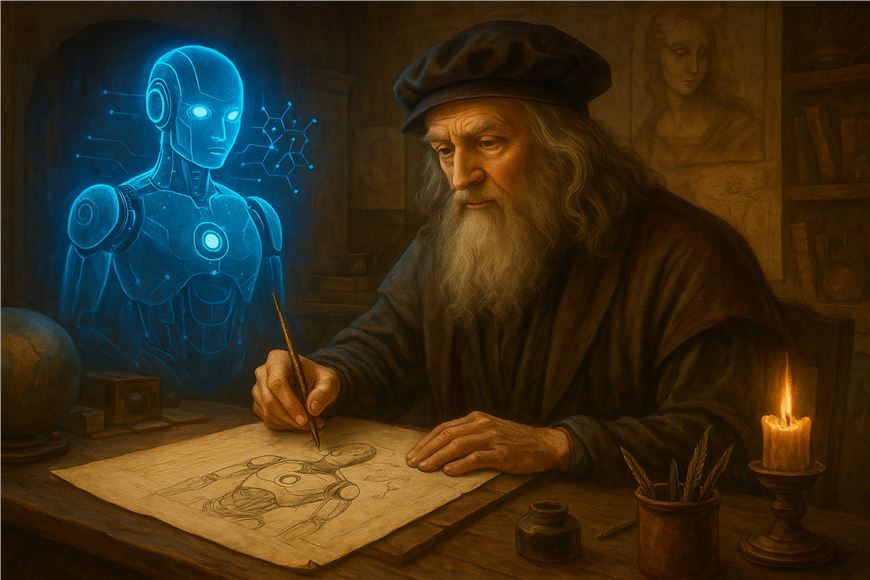
In the year 2026, as humanity stands on the precipice of a cosmic expansion, we find ourselves echoing the spirit of the Italian Renaissance—a period when art, science, and exploration converged to propel civilization forward. Today, this rebirth manifests not in frescoes and cathedrals but in algorithms, orbital habitats, and the digital corridors connecting distant shores. From the bustling innovation hubs of Orlando, Florida, to the timeless elegance of Milan and Rome, a "New Renaissance" is unfolding. This editorial essay explores how artificial intelligence (AI) and space exploration are intertwining with cultural and economic forces to redefine human potential. Drawing on the themes of beauty, power, and rebirth, we delve into the signals from this emerging era, where technology serves not as a disruptor but as a catalyst for a more profound human flourishing.
Cybereport.com, as a global dispatch from these corridors, positions itself at the intersection of America's entrepreneurial vigor and Italy's artistic heritage. Orlando, with its aerospace legacy tied to Kennedy Space Center and burgeoning media ecosystems, emerges as a gateway to the stars. Milan, the epicenter of luxury and finance, infuses this movement with aesthetic sophistication, while Rome's diplomatic and spiritual gravitas reminds us of the ethical imperatives guiding our ascent. The Caribbean and Latin America add layers of cultural diversity, fostering a truly global renaissance. In this premium essay, we argue that this fusion is not mere coincidence but a deliberate evolution, one that demands we harness AI's intelligence and space's vastness to reclaim our civilized essence.
The AI Renaissance: From Machines to Muses
The original Renaissance was ignited by rediscovered classical knowledge, amplified by inventions like the printing press. Similarly, AI in 2026 acts as a modern muse, democratizing creativity and problem-solving on an unprecedented scale. Consider the advancements in generative AI models, which now collaborate with artists and scientists to produce works that blend human intuition with computational precision. In Orlando's tech incubators, startups are using AI to simulate space missions, optimizing trajectories for Mars-bound crafts while incorporating artistic renderings inspired by Michelangelo's anatomical precision.
Yet, this is no utopian fantasy. AI's integration into daily life raises profound questions about power dynamics. In the Wealth & Power corridors of Milan, financial algorithms predict market shifts with Renaissance-like foresight, drawing parallels to the Medici bank's patronage of the arts. These systems, powered by vast datasets from global observatories, enable investors to navigate economic turbulence with the grace of a Botticelli painting. However, as we witness in Rome's policy circles, unchecked AI could exacerbate inequalities, concentrating power in the hands of a digital elite. The New Renaissance calls for a balanced approach: AI as a tool for empowerment, not domination.
Take, for instance, the "Renaissance Codes" initiative, alluded to in recent Cybereport signals—a conceptual framework where AI deciphers ancient texts to inform modern ethics. In 2026, projects like these are bridging the gap between Silicon Valley's code and the Vatican's archives. Orlando's educational institutions, such as the University of Central Florida's AI programs, are training a new generation of "digital humanists" who code with the soul of da Vinci. This corridor exemplifies how AI can revive cultural heritage: imagine AI-restored virtual tours of the Sistine Chapel, accessible via augmented reality from a Caribbean beach or a Latin American metropolis.
Critics argue that AI dilutes human creativity, reducing art to algorithms. But history teaches otherwise. The Renaissance thrived on tools like perspective drawing, which enhanced rather than replaced the artist's vision. Today, AI muses generate symphonies in the style of Puccini, as seen in recent cultural events chronicled on Cybereport. In the Culture & Renaissance section, we see signals of this rebirth: operas reimagined with neural networks, where AI composes variations on Tosca, performed in Milan's La Scala with holographic projections. This is the essence of the New Renaissance—technology amplifying beauty, not supplanting it.
Space Exploration: The Ultimate Canvas for Human Ambition
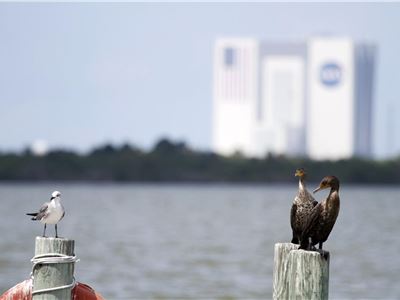
If AI is the brush, space is the infinite canvas. In 2026, with private enterprises like SpaceX and Blue Origin launching weekly missions from Florida's Space Coast, Orlando stands as America's renaissance gateway to the cosmos. The Tech & Space signals on Cybereport highlight this: reusable rockets ferrying payloads to lunar bases, where AI-managed habitats sustain life amid harsh vacuums. This expansion mirrors the exploratory zeal of Columbus, sponsored by Renaissance patrons, but with a twist—today's voyages are collaborative, involving Italian aerospace firms like Leonardo S.p.A., which provide AI-driven satellite tech from Milan's innovation districts.
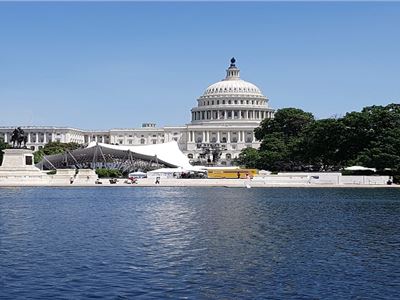
The power implications are staggering. Space resources, from helium-3 for fusion energy to asteroid minerals, promise to reshape global economies. Washington D.C.'s institutional corridors, as noted in Cybereport's Wealth & Power analyses, are abuzz with treaties governing orbital real estate. Here, the New Renaissance demands ethical stewardship: will space become a domain of inclusive progress or a battleground for superpowers? Rome's diplomatic heritage offers a model, advocating for space as a "common heritage of mankind," akin to the Renaissance's humanist ideals.
Culturally, space inspires a rebirth of wonder. Sunday Magazine's Voyages section on Cybereport captures this—profiles of astronauts training in Orlando's simulators, their narratives infused with Renaissance poetry. Imagine Dante's Inferno reinterpreted as a journey through black holes, visualized by AI artists. The Caribbean corridor adds vibrancy: Puerto Rican engineers contributing to NASA's Artemis program, blending Afro-Caribbean rhythms into space station designs. Latin America's role, from Brazil's satellite launches to Mexico's AI observatories, underscores a polyphonic renaissance, where diverse voices harmonize in the void.
Yet, challenges abound. Environmentalists decry the carbon footprint of launches, while ethicists question AI's role in autonomous space weapons. In this essay, we posit that the New Renaissance must prioritize sustainability: AI-optimized green propulsion systems, developed in Orlando-Milan collaborations, could mitigate these risks. As Roberto Masiero's recent signal, "When Power Starts Listening," suggests, true power lies in heeding these echoes—integrating space's vastness with earthly wisdom.
Wealth, Power, and the Ethical Imperative
The corridors of wealth and power form the backbone of this renaissance. In Milan, luxury brands leverage AI for personalized fashion, echoing the patronage of Lorenzo de' Medici. Cybereport's Wealth & Power section tracks these trends: blockchain-secured art NFTs traded in Rome's galleries, with proceeds funding space ventures. Orlando's media ecosystem amplifies this, producing documentaries on the "Renaissance Evolution," as seen in Ivette Castro's "Back to the Renaissance Voyage 2026."
But power unchecked breeds corruption. The New Renaissance must confront this: AI surveillance in D.C.'s institutions could erode privacy, while space militarization threatens peace. Drawing from Books & Ideas, we reference forthcoming works like "The Renaissance Codes," which advocate for "letters on beauty and power"—epistolary reflections urging leaders to wield technology with humanist grace.
In the Caribbean and Latin America, this imperative is acute. Emerging economies risk exploitation in the space race, yet they offer vital perspectives: indigenous knowledge informing AI environmental models, or Cuban biotech enhancing space medicine. Cybereport's Global Observatory signals these opportunities, calling for inclusive corridors where power flows bidirectionally.
Conclusion: Letters to the Future
As we conclude this essay, envision a world where AI and space propel a New Renaissance, reconnecting us to our civilized roots. From Orlando's launchpads to Rome's forums, the signals are clear: this is an era of rebirth, where technology serves humanity's highest aspirations. Yet, it requires vigilance—ensuring AI enhances rather than erodes our essence, and space unites rather than divides.
In the spirit of Cybereport's Premium Editorial Essays, this piece is a dispatch from the corridors, an invitation to patrons and readers alike. Support the Cultural Sovereign Fund; subscribe to the Intelligence Feed. Together, we decode the renaissance, forging a legacy worthy of our ancestors. As the stars beckon, let us listen to the echoes of beauty, power, and rebirth.
- Tags:
- Categories: Premium Editorial Essays